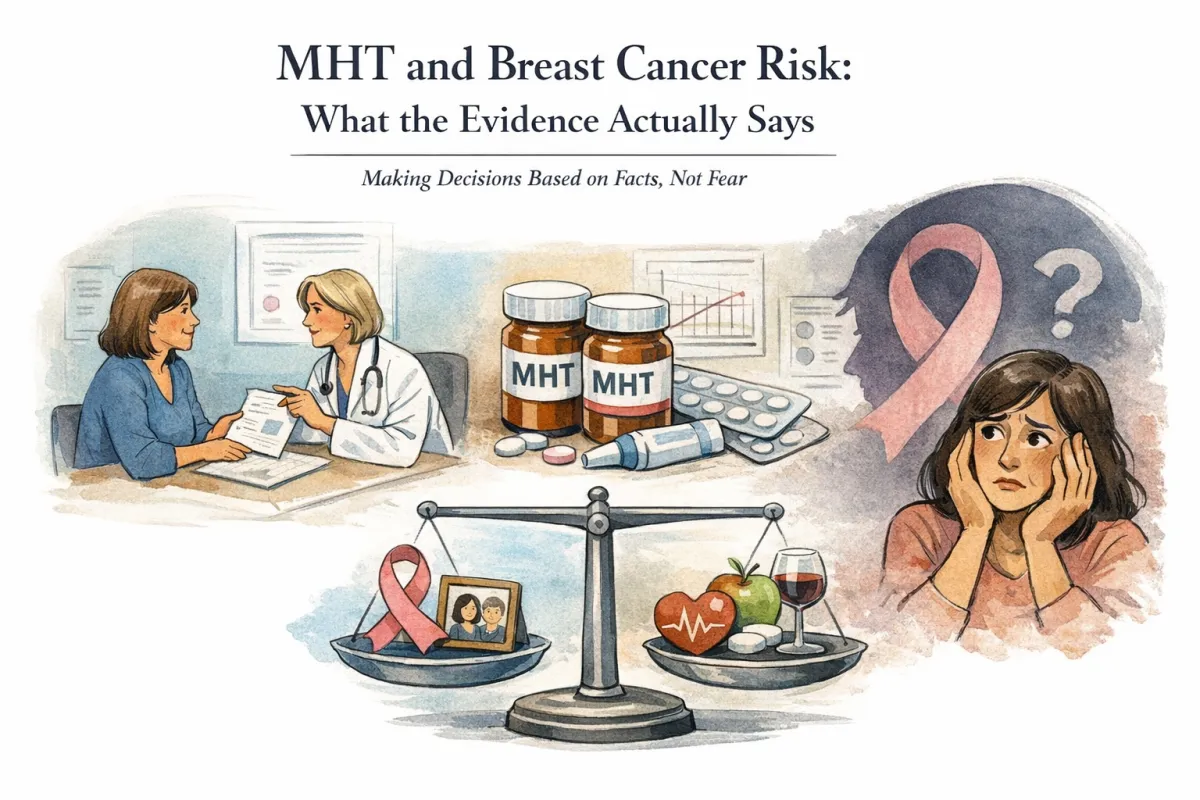
Hormone Therapy and Breast Cancer Risk: What the Evidence Actually Says
So many women I talk to about menopausal hormone therapy have the same question. They want to know about breast cancer risk.
I understand the fear. My mother has had three primary breast cancers. Not a recurrences. Three separate cancers.
And I take MHT for my perimenopausal symptoms.
I didn't make that decision lightly. I made it because I've looked at the data, discussed my risk with my doctor, and made a decision that was right for my body. The truth is that the science tells a very different story than most women have heard.
How We Got Here
In 2002, the Women's Health Initiative study made headlines that scared an entire generation of women and their doctors away from hormone therapy. The takeaway was simple: hormones cause breast cancer. Full stop.
It wasn't just about breast cancer, either. The study also linked combined MHT to increased risk of cardiovascular disease, blood clots, and stroke. Doctors who had been prescribing hormones for decades stopped cold. Women who were doing well on MHT were pulled off of it. The whole field retreated.
Since then, the data has been thoroughly re-examined. Much of the original risk was driven by the age of the study participants (many were over 60 and well past menopause when they started hormones) and the specific formulations used. In November 2025, the FDA removed the black box warning from estrogen-containing MHT products, acknowledging that the original warnings overstated the risks, particularly for women who start therapy within 10 years of menopause or before age 60.
That's a big deal. But it also brought a flood of new questions, especially for women with family history of breast cancer.
The Actual Numbers
When you learn the numbers, it is easier to see how MHT is a valid option for women with a family history of breast cancer.
An average woman has about a 9.8% chance of developing breast cancer by age 80. Five years of combined MHT starting at age 50 brings that to roughly 11%. Ten years brings it to about 12.4%.
That's an absolute increase of about 1 to 2.5 percent. For context, that's less than the increased risk associated with having two glasses of wine a night.
And no studies have shown that MHT increases a woman's risk of dying from breast cancer.
The Type of Hormone Therapy Matters
The details really matter here.
Estrogen alone (for women who've had a hysterectomy) has not been shown to increase breast cancer risk. The WHI data actually showed a decrease in breast cancer incidence with estrogen-only therapy. One important note here: the WHI used conjugated equine estrogens (Premarin) which is used less commonly these days, recent observational data on 17β-estradiol (used more commonly these days) did not show an increased risk of breast cancer.
Combined MHT (estrogen plus a progestogen) is where the modest risk increase shows up. And the type of progestogen matters. Synthetic progestins carry the highest associated risk. Micronized progesterone (like Prometrium) has a more favorable profile and may not increase risk at all when used for less than five years.
Vaginal estrogen doesn't increase breast cancer risk. Full stop. The hormones stay local with minimal systemic absorption. This is true even for women who've had breast cancer.
"But My Mom Had Breast Cancer..."
Family history alone is not a contraindication to MHT.
A January 2025 study in the British Journal of General Practice looked at how MHT affects women across different levels of family history risk. Even women with a strong family history saw only a modest additional risk from MHT, about 1 to 3 percent absolute increase with five years of use. That's similar to women without any family history at all.
The WHI data confirmed something important here: family history and MHT have independent, non-interacting effects on breast cancer risk. Having a family history doesn't multiply or amplify the risk from MHT. They just add together.
There's more. Emerging evidence presented at the 2025 San Antonio Breast Cancer Symposium showed that among BRCA1 and BRCA2 carriers, MHT was not associated with increased breast cancer risk. Estrogen-only MHT was actually associated with lower breast cancer incidence in BRCA carriers compared to non-users.

And this is why I feel comfortable taking MHT despite my mother's history. The science supports it, my personalized risk assessment supports it, and my quality of life matters.
After a Breast Cancer Diagnosis
This conversation is a little different, and it should be.
Current guidelines from ACOG, The Menopause Society, and most major oncology organizations still consider a personal history of breast cancer, particularly hormone receptor-positive breast cancer, to be a contraindication to systemic MHT. The concern is about recurrence, not developing a new cancer.
But the conversation is shifting. A landmark 2025 expert consensus statement published in the journal Menopause called for a more patient-centered approach. For women with persistent, severe symptoms who have tried everything else, systemic MHT may be considered after careful discussion with both the menopause specialist and the oncology team.
A few things worth knowing: Vaginal estrogen is generally considered safe for breast cancer survivors. Non-hormonal options exist too, including SSRIs, gabapentin, cognitive behavioral therapy, and newer medications like fezolinetant (Veozah). And any decision about systemic MHT after breast cancer should involve the full medical team. This isn't something to figure out alone or with a virtual provider in a 10 minute chat.
What I Want You to Take Away
If you have a family history of breast cancer, the evidence is clear that it doesn't amplify MHT risk the way most people assume. You deserve a provider who will sit down, look at your individual numbers, and walk through the actual data with you. Not someone who reflexively says no because it feels safer.
If you've had breast cancer yourself, systemic MHT is still generally contraindicated. But the door isn't completely shut for everyone, and vaginal estrogen is considered safe. This is a conversation to have with you care team which includes your oncologist.
I chose MHT knowing my family history. I looked at my individual risk, I looked at the evidence, and I made a decision I feel good about. That's what I want for every one of my patients: not a blanket yes or no, but a real conversation grounded in data, not fear.
Taking hormones is a personal decision. It requires a detailed conversation with your doctor, a look at your individual risk factors, and honest weighing of what matters to you. But that conversation should start with accurate information, not outdated fear.
This post is for informational purposes only and does not constitute medical advice. If you're navigating menopause, with or without a history of breast cancer, I'd encourage you to work with a clinician experienced in menopause management to discuss your individual risk.
Wondering if MHT is right for you? Schedule a free 15-minute discovery call with Sorrel Health & Wellness.