How to Start Strength Training in Midlife: A Beginner's Guide for Women
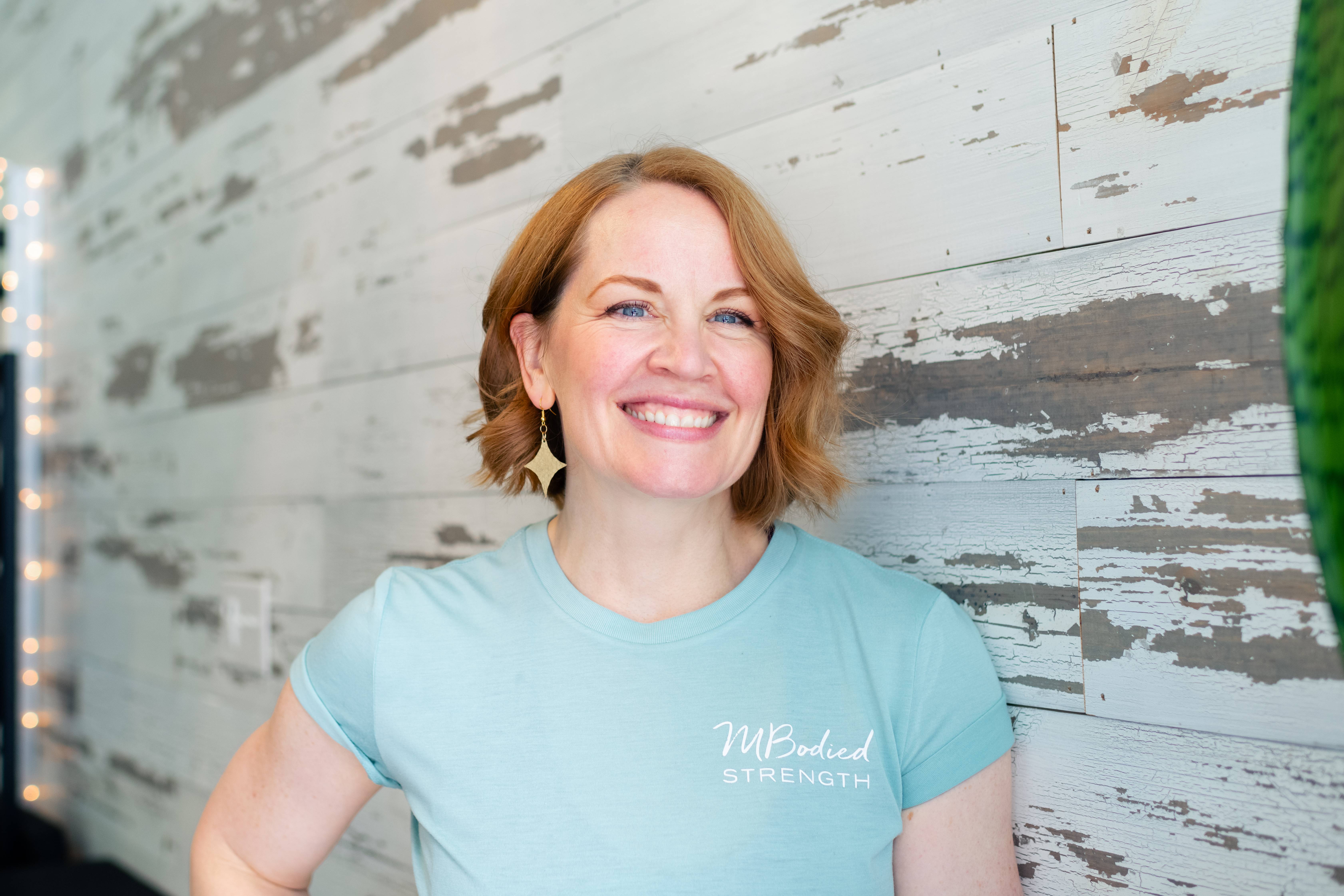
We're excited to feature Melissa Charlton of MBodied Strength as a guest contributor on the Sorrel Health & Wellness blog.
At Sorrel Health & Wellness, we talk with our patients every day about the role resistance training plays in metabolic health, bone density, and navigating the changes that come with perimenopause and menopause. The evidence is clear — strength training matters. But knowing you should lift and knowing how to start are two very different things.
So you’ve heard that you need to start lifting heavy if you want to increase your bone density and support your longevity goals. FANTASTIC! Thank goodness our culture is shifting, and people are finally on board with women getting stronger.
The only issue is, it can be really hard to know how to start!
What follows is a guide so you can start lifting, lessen your chances of injury, and challenge yourself all at the same time.
There are exceptions and arguments to be made, of course, but this is the best advice I can give. So please take all of this as a jumping off point, not the end-all of strength training.
Step 1: Wake up your body, before you challenge it
Stiff muscles don’t allow for full range of motion, and are often a precursor to injury. Plus, restricted muscle and joints hurt! There are many resources available for troubleshooting your pain, but the best teacher is your own curiosity.
Ask yourself:
Where is there joint pain or muscle stiffness?
What do I do everyday that causes pain (e.g. shoulder hurt when you reach for the seatbelt, back hurts when you walk,)
What you can do:
Roll & Massage areas that feel tight
Here are some links for self-massage of your hamstrings, ITBand, hips, neck, and shoulders.
Mobilize your joints and muscles.
Here are a few of our favorites for your spine, all in one video.
Practice CARs, aka, Controlled Articulated Rotations.
Coach Melanie demonstrates some good ones in this instagram carousel, for those of us in desk jobs
Step 2: Activate – In order to have stability during your lifts, you need to turn on your stabilizing muscles.
We do our core work early during a session, so the muscles are turned on and ready for when you get to your heavier lifts.
Add some hip, shoulder and feet activation, and you’re not only going to avoid injury, you’ll be strengthening your postural muscles for life outside the gym.
Here are a few links that might help:
Step 3: Learn and practice all the main lifts, so your body gets functional strength
The main lifts are linked below. There are hundreds of ways to do each of them, but there are only seven main movements:
Hinge (deadlift)
Push (chest press & overhead press)
Pull (rows and pull-ups or lat-pull-downs)
Carry (or march)
Core Rotations. (I’ve only linked the moves that may not sound familiar).
I like to pair upper and lower body moves on the same day, and I would suggest that a beginner do the same until you've established a good habit. It can help you get full-body work, and if you accidentally skip a day, you’ve at least hit more of the main lifts..
Once you've gotten the habit & movement patterns down, you can try doing an all upper body day or all lower body, see what you like more. There are numerous ways to organize your workouts.
As long as you are hitting each of those main lifts for 3-4 sets a week, you're golden!
This is where you might want to purchase a program. (I don’t recommend AI. The programs I’ve seen it create are not to be trusted.) If you can’t afford a trainer, thereare many apps that provide reasonably priced pre-existing programs you can get as a subscription. Look for some that require a good warm up (steps 1 & 2 of this blog)
Step 4: How do you choose the weight? You gotta feel it out.
In the beginning, choose weight that you can lift for 8-12 repetitions of each exercise, seeking fatigue. We’re looking for something just heavy enough that you might not quite finish that 12th rep.
Play around and don't be afraid to lower the weight if you need to. Safety is more important than ego or impressing someone at the gym who likely isn’t even looking at you.
Once you can complete 12 reps, it’s time to go up in weight and down in reps.
Caveat: Stability and core moves are usually programmed as higher reps, 12-18. This is because we’re training endurance muscles, and they require more time under tension. It’s the main lifts where we want medium then heavy weight.
Step 5: Goals determine how many reps per set
If working towards maximal strength, try for 5 sets of 3-5 reps per move, making sure to give enough time between sets to recover (2 minutes of rest is ideal. If you’re short on time, 1 minute of rest is ok, but you might hit your strength limit a little sooner).
If you want more muscle appearance (bigger biceps), aim for 8-12 reps and reduce your rest intervals. Don’t be afraid of getting bulky. The bulk we see on women body-builders comes from hormonal help. Remember, muscles need to have some size, and then they increase your metabolism, which helps lean you out. Bigger muscles + fat-loss = “that toned look”.
If you want to train muscle endurance, aim for 15-20 reps, or slooooow down your tempo. This is great for calf raises for runners, shoulder blades, wrist, core and hip moves. Basically, the muscles that promote good posture or would be needed for longer activities need to be trained for that purpose.
Circuit training can maximize your time and adds a little cardio challenge to your lifting days. Essentially, while one muscle group is resting, take half a minute of rest before moving to the next muscle group. This causes the heart to work really hard, pumping blood to the whole body for your entire session.
Step 6: Repetition builds strength and resilience – Don’t switch it up for at least 6-8 weeks
I know it can feel a little boring, doing the same thing every week. But if you switch up a program too often, you won’t progress as fast, and you definitely won’t train the coordination required for good form during heavy lifts. Plus, it’s one less thing to think about!
Step 7: Fuel
Don’t calorie-restrict, at first. When you eat too little, it’s very hard to build muscle. It also makes focus, sleep and mood more difficult to manage. Eat protein and veggies and grains and healthy fat.
Eat lightly before a strength session, so you have energy but don’t get nauseous during the workout. Eat again soon after the workout, so your body has the best chance of creating muscle and maintaining focus.
In my opinion, cheat days are a kind of disordered eating, in that they encourage an all-or-nothing mentality that can lead to bingeing and starving.
It’s ok to eat treats, as long as that’s not all you eat. Instead of believing that treats should be “earned” or need to be “burned off”, try to enjoy your food and notice how you feel when you eat. If you eat so much you feel uncomfortable, you know you overdid it. This isn’t a nutrition blog, but I care about food a lot.
Step 8: Recovery
Try to take at least 48 hours off between muscle groups. This gives your body time to rebuild muscle, before you challenge it again. (This is why people do upper and lower moves on separate days, but that technique is for people with enough time to lift 4-5 days/week)
Sleep. Muscle grows while we sleep, so cut down on your alcohol (because it interrupts sleep), improve your sleep hygiene, and try to go to bed on time.
Foam roll, stretch and move your body on your non-lifting days, so you can stay supple and decrease the stiffness that comes with this kind of work.
Step 9: Do less when life interrupts. (That way you can stay the course)
Some days, it’s all I can do to just show up to my workout (and I own a gym!). Today, I only had time for half my workout, and it was so tempting to just skip the whole thing. But I know that I won’t have time tomorrow, so I just did half today. And that’s ok, because I still strengthened my habit. And even just half the workout helped me with my stress and gave my muscles some motion.
On the days I just don’t feel like it? I give myself permission to only do the warm up. Again, I’m strengthening my habit, and I usually find that I don’t want to stop, once I’ve begun. So even on the days you just don’t wanna? Commit to just 5 minutes, and then quit if you still need to.
Step 10: Celebrate every win! It makes it more fun, and helps with commitment.
Muscle gains come a bit more slowly, and that can make us want to give up before we see real progress. Therefore, look for other things to celebrate to help you keep going.
Sleep, posture, confidence, lower stress, clothes fitting better, and pain relief are all things that improve with strength training.
Lifting heavier is a great goal by itself. But here are some other lifestyle goals our clients have brought us:
Lifting the suitcase in the overhead compartment
Catching yourself when you trip
Not having pain after a hike
Having the strength to open your own jars
Saying “yes” when invited to adventures that used to intimidate you
Sticker charts sound silly, but they help me track my habits when I’m feeling otherwise stalled in my progress. I’m also a big fan of shouting out my wins to the world. (This gives others permission to brag about their wins, too!)
Seek action, instead of perfection. I feel like all the above advice is solid, but it can look like a LOT to do. It’s ok to do only some of it. Remember we just want you to start.
Did you make it this far? Great job, that was a lot. There’s so much more I can tell you, but I feel like I’ve taken enough of your time. And everything above is pretty much our formula, at MBodied Strength.
If you want to learn more about strength training, it’s my favorite subject. Feel free to drop me a line at [email protected], check out our Instagram Page @mbodiedstrength, and keep following our blog at https://mbodiedstrength.com/blog.
MBodied Strength offers a paid trial for new clients. Mention that you found them through the Sorrel Health & Wellness blog and receive $100 off getting started!

Melissa Charlton
NASM CES, GGS Menopause Strength Coach
Melissa Charlton is the founder of MBodied Strength, a personal training studio for Seattle's executive women. Certified as a NASM Corrective Exercise Specialist and a GGS Menopause Strength Coach, she brings over 20 years of personal training experience that combines pain management, biomechanic fixes, and a curiosity for all movement.
MBodied Strength's team of compassionate, badass trainers want to teach you to listen to your body, while delivering a program that makes lifting fun. Our ultimate goal is to help you get strong, confident, and finally trust your body again.
The views and recommendations in this post are Melissa's own and do not constitute medical advice from Sorrel Health & Wellness.